When reviewing corporate gift procurement projects after completion, there is a recurring pattern that rarely gets flagged during execution but consistently undermines the intended outcome. The gifts themselves meet quality standards. Recipients do not complain. Yet the overall impact of the gifting initiative falls noticeably short of what was planned. In most cases, the issue is not that the wrong product was chosen, but that the right product was configured with the wrong specifications for the wrong scenario.
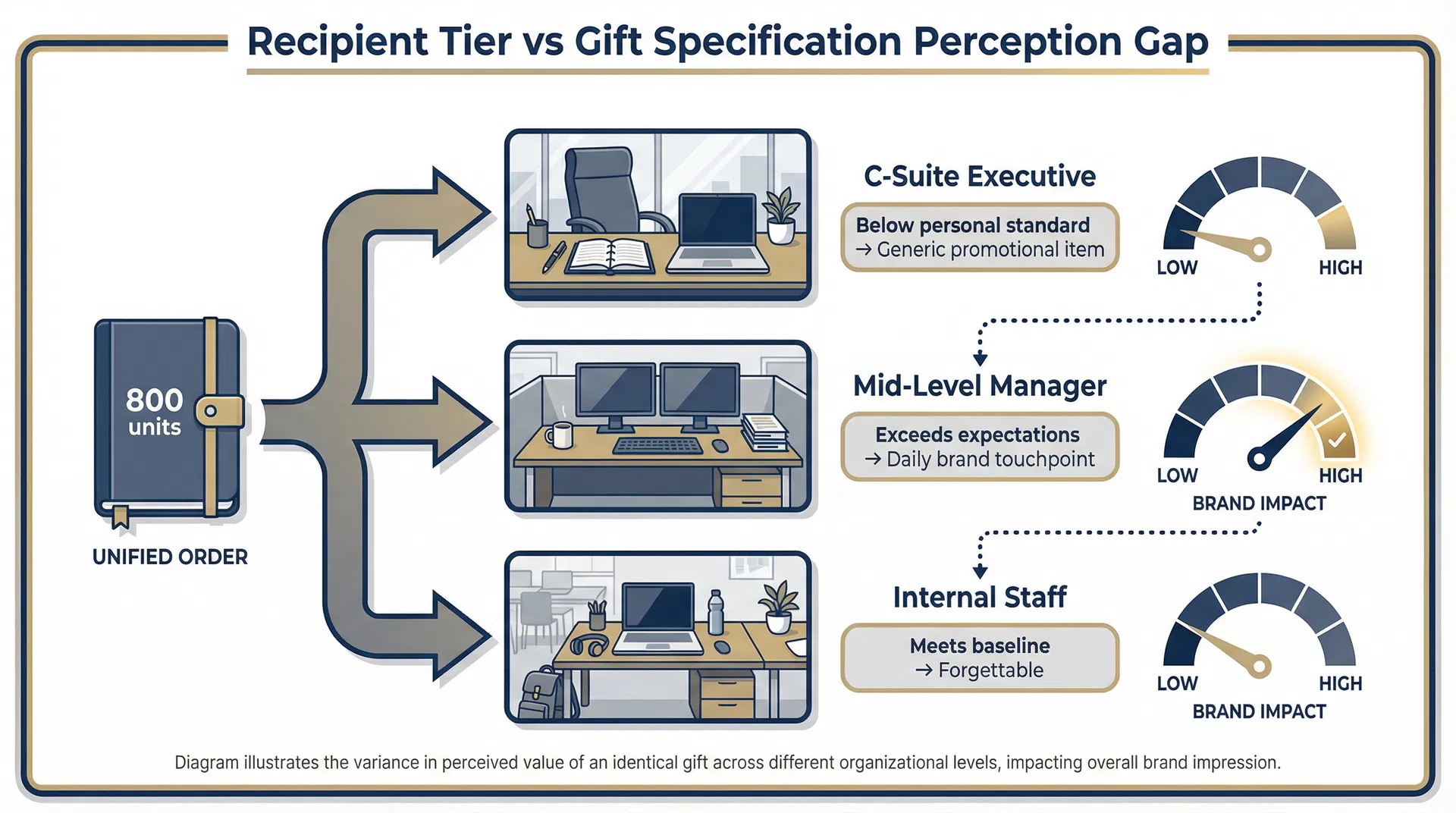
This pattern is particularly pronounced in custom stationery gifts. Notebooks, pens, desk organizers—these items are typically categorized by product type in procurement workflows. But in actual business contexts, the same custom notebook serves fundamentally different functions depending on whether it is distributed at a trade show, sent as a client retention gift, or included in an employee onboarding kit. When the procurement decision stays at the level of "we need to order 500 custom notebooks," the downstream specification choices will almost inevitably produce a mismatch.
Consider the trade show scenario. The notebook's core function here is immediate interaction triggering. Visitors at a booth typically spend less than three minutes before moving on. The gift must complete its brand message delivery within that window. This means the cover design needs high visual recognition, the brand logo must be immediately identifiable in terms of placement and scale, and the notebook's size and weight must account for whether attendees will actually carry it in their tote bags. In this context, the paper quality of the inner pages is a secondary concern—most trade show visitors will not open and use the notebook on-site.
The same notebook, repurposed as a client retention gift, shifts its core function to brand memory retention. The client will place it on their desk and potentially use it daily. Now the writing experience of the inner pages becomes critical. If the paper quality causes ink bleeding with fountain pens or inconsistent ballpoint flow, the client's impression of the brand may actually deteriorate because of the gift. The cover design also needs to pivot from high-recognition branding to understated elegance—no one wants to display what looks like a promotional item on their office desk.
The third scenario, employee onboarding, assigns the notebook a belonging-establishment function. The first company item a new employee receives directly shapes their initial impression of the corporate culture. In this context, the overall packaging presentation, visual coherence with other items in the welcome kit, and even whether the inner pages carry the company's core values or team introduction matter far more than logo printing alone.

In practice, this is often where corporate gift type decisions start to be misjudged—not because procurement teams lack product knowledge, but because the structural design of the procurement process itself creates the conditions for mismatch. In most organizations, gift procurement is executed centrally by administrative or procurement departments, while the actual usage scenarios are distributed across business development, human resources, and marketing teams. When the procurement team receives a request that simply reads "order 500 custom notebooks," they will naturally apply a unified specification—a mid-range material, a generic design template, a standard printing technique. This decision is entirely rational within the procurement workflow, but it may simultaneously underserve all three usage departments.
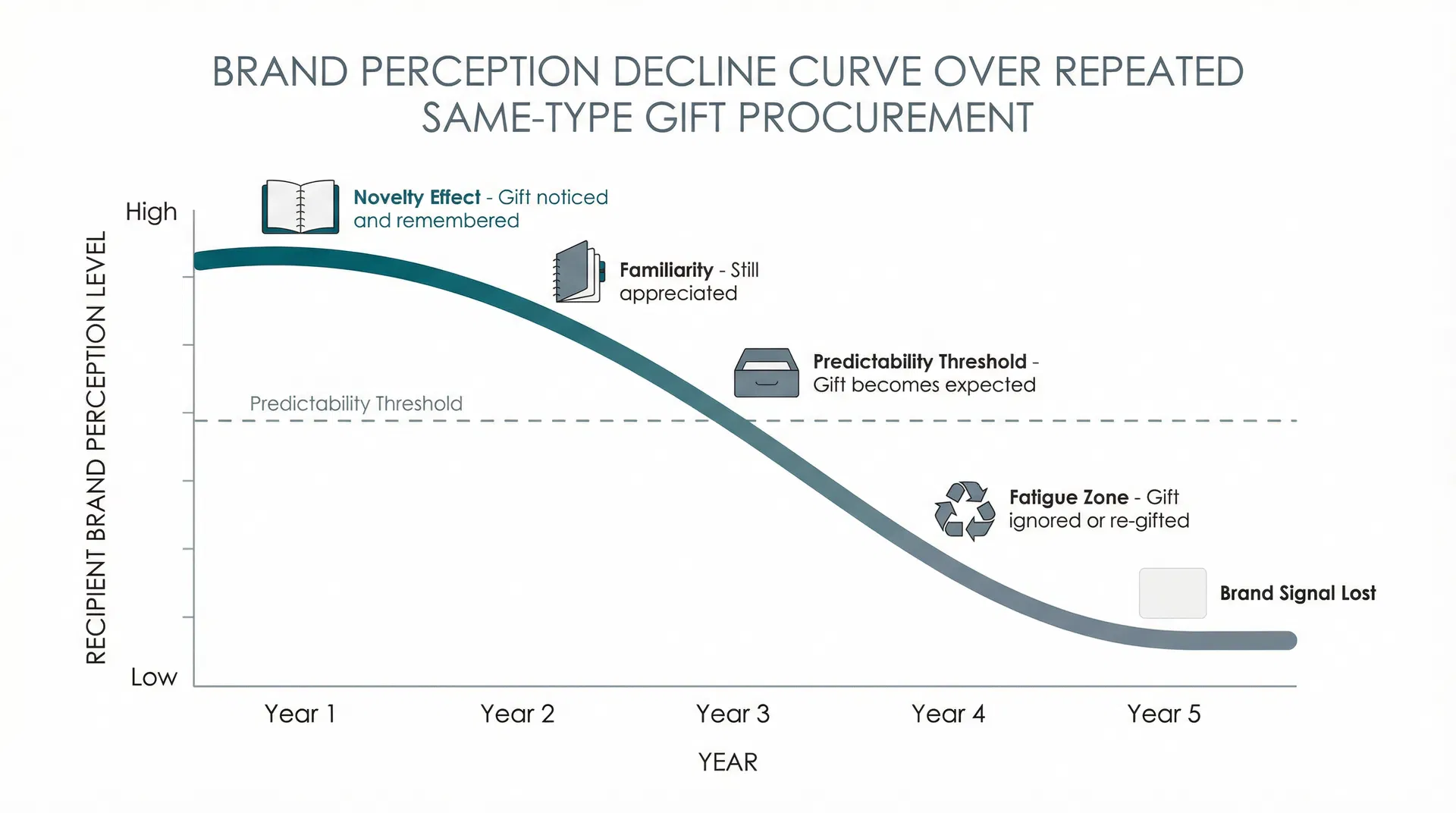
The deeper issue is that the consequences of this mismatch rarely surface as formal complaints. No trade show visitor will formally report that the notebook was too heavy to carry. No client will reply to a gift with feedback about paper quality. No new employee will file a complaint about the onboarding kit's visual coherence. The consequences are invisible—lower-than-expected brand exposure at the trade show, diminished client relationship maintenance effectiveness, a forgettable onboarding experience. Because these outcomes are difficult to attribute to gift specification choices, the same mismatch repeats in the next procurement cycle.
From the perspective of corporate gift procurement strategy, the effective approach is not to plan budgets and specifications by product category, but to first clarify the core functional requirement of each usage scenario, then reverse-engineer the corresponding product specifications. This may sound like it adds complexity to the procurement process, but in reality it simply makes the scenario confirmation step explicit rather than implicit. Spending an extra half-day at the project's outset to confirm scenario requirements with each usage department is far more efficient than discovering at the project's conclusion that the results fell short—without being able to identify why.

Another dimension that is frequently overlooked is that different business scenarios demand entirely different customization techniques. Trade show giveaways typically require high-volume, fast-turnaround production, making screen printing or digital printing the rational choice. Client retention gifts may call for hot stamping or laser engraving to convey a sense of quality. Employee onboarding kits that involve multiple items with visual consistency may benefit from UV printing's advantage in color uniformity. If the procurement team does not differentiate these scenario requirements when placing the order, the factory receives a single unified specification, and the resulting products will be merely adequate in every scenario rather than genuinely appropriate for any of them.
The root of this judgment blind spot is not a lack of product expertise on the procurement side. It is that the entire decision framework begins at the wrong starting point. When a gift procurement project opens with "what product do we need," every subsequent specification choice is guided by the product's inherent attributes. But if the starting point shifts to "what function does the gift need to fulfill in this scenario," the same product category will naturally differentiate into entirely distinct specification directions—and those directions are the variables that ultimately determine whether the gifting initiative achieves its intended business outcome.